admincb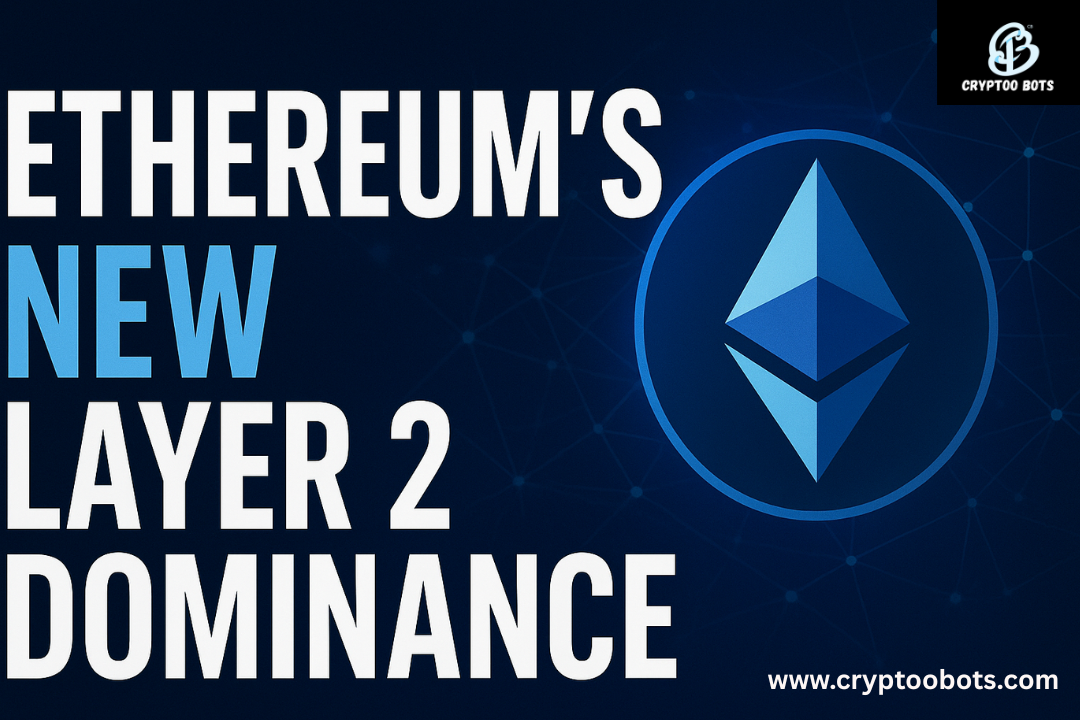
Introduction
If the past was Ethereum’s era of smart contracts, then 2025 may well be the era of Layer 2 dominance. Ethereum’s base layer is no longer carrying the entire load rollups and Layer 2 solutions are taking over the heavy lifting. But this shift isn’t just about scaling; it’s redefining how developers, users, and investors view the network’s future.
Let’s dig into how Ethereum’s Layer 2 dominance has emerged, what’s fueling it, the risks it faces, and what it means for the blockchain world ahead.
Why Layer 2 Matters
Ethereum’s base chain provides security and decentralization, but it has finite throughput and high costs when congested. That’s the classic trilemma: you can’t optimize all three (scalability, security, decentralization) at once. Layer 2 solutions inherit Ethereum’s security while pushing throughput and cutting costs.
In 2025, many users don’t even see the main chain they just interact with rollups that confirm quickly and cheaply. That’s powerful.
The Landscape: Major Layer 2s Leading the Charge
Ethereum’s Layer 2 ecosystem is diverse. Some of the most influential players:
- Arbitrum: A leading optimistic rollup with broad adoption in DeFi and dApps.
- Optimism: Strong in governance, with its “Superchain” vision and interconnectivity.
- Base (Coinbase’s L2): Offers tight integration with the Coinbase ecosystem, making onboarding seamless.
- zkSync, StarkNet ZK-rollups using zero-knowledge proofs for strong scalability and security.
- Others: many L2s and rollups are emerging, each competing in speed, cost, security.
As of early 2025, over US$ 40+ billion is locked in various Layer 2 chains across Ethereum’s ecosystem.
Key Drivers Behind Ethereum’s Layer 2 Dominance
Proto-Danksharding & Data Efficiency
Ethereum’s Dencun upgrade, including EIP-4844 (proto-danksharding), introduced “blobs” cheaper data availability for rollups. This significantly lowers the cost for L2s to post data to the main chain, making rollups more efficient.
Future Pectra upgrades aim to further optimize how rollups interact with Ethereum’s base, making Layer 2 even more cost-effective and scalable.
Massive Adoption in Transactions & Usage
Many Layer 2s now process more transactions daily than Ethereum’s base layer. In 2025, L2 networks have begun to absorb the bulk of user activity, from simple transfers to complex DeFi operations.
This shift pushes Ethereum’s role to one of settlement and security, while L2s handle the routine stuff.
TVL & Capital Flow Into L2s
Liquidity and value locked in L2s have surged. The more capital moves into Layer 2 networks, the more network effects they gain projects, developers, users all flock to where liquidity is.
Institutional & Developer Confidence
Institutions and builders increasingly view Ethereum + L2 as a safe, scalable setup. The ecosystem’s maturity, strong developer tooling, and security track record make them comfortable building and investing there.
Ethereum Dominance Metrics: ETH vs L2s
A popular metric in crypto is “dominance” the share of total crypto market cap held by Bitcoin or Ethereum. But in a layered world, a new lens is emerging: L2 dominance within Ethereum’s ecosystem.
- ETH Dominance: Ethereum’s share relative to all cryptos. In September 2025, ETH dominance sits between 13–15%, recovering from an earlier low near 6.95%.
- L2 Dominance: How much of Ethereum’s activity, value, and transactions reside on L2s versus the base chain. By many measures, L2s already handle the majority of economic activity in the Ethereum world (transactions, DeFi volume, etc.).
- Interdependence: The health of Ethereum’s base and its L2 network success are intertwined. Strong L2s reinforce Ethereum’s central position rather than undermining it.
Examples of Scaling in Action
- Optimism’s Superchain Vision
Optimism is building toward a connected network of rollups and shared security, aiming for seamless interoperability. - Arbitrum Upgrades & Decentralization
Arbitrum’s BoLD upgrade removed validator whitelists, enhancing decentralization and trust in its rollup model. - zkSync & ZK Rollups
ZK rollups offer cryptographic proofs of correctness, enabling fast finality and high scalability. Projects are pushing zkSync and StarkNet solutions. - Cross-chain Bridges & Integration
Many L2s support bridging to other chains, making assets more mobile while users still benefit from Ethereum’s security.
Advantages & Strengths of Ethereum’s L2 Dominance
- Cost Efficiency: Transactions that would cost $5–20 on L1 might cost cents on L2.
- Speed & Throughput: Thousands of transactions per second across rollups.
- Security Inheritance: L2s leverage Ethereum’s cryptographic security model.
- Network Effects: Developers and users prefer where liquidity and demand are.
- Developer Ecosystem: Tooling, libraries, composability make L2 development smoother.
Challenges & Risks to Watch
No ecosystem is without challenges. For Ethereum’s L2 dominance, key risks include:
- Security Vulnerabilities: Bugs or exploits in rollup contracts or bridges.
- MEV Complexity: Optimistic L2s especially are affected by Miner/Maximal Extractable Value dynamics. A study found optimistic MEV accounted for over 50% of on-chain gas in some L2s in Q1 2025.
- Competition from Other Base Chains: New smart contract blockchains (e.g. Solana, Sui, others) may lure developers away.
- Regulation & Compliance: Legal frameworks might impact how rollups operate, especially when they interact with off-chain systems.
- Overcentralization: Some L2 systems may rely too heavily on a small set of sequencers or validator nodes, risking censorship or single points of failure.
What It Means for Users, Developers & Investors
- Users will enjoy lower fees, faster confirmations, and better UX for interacting with dApps.
- Developers will see more growth in L2-native tools, better composability, and more opportunity to launch projects without L1 constraints.
- Investors can look at L2 tokens or infrastructure projects as potential high-growth plays, especially those securing real usage rather than hype.
The Road Ahead: What’s Next
- Pectra and Beyond: Ethereum’s Pectra upgrade is designed to improve throughput and further enable L2 scaling.
- Inter-L2 Composability: Smoother interaction between different rollups, unified user experience.
- Advanced Rollup Types: Innovations in ZK, optimistic hybrids, and data availability layers.
- More Real-World Use Cases: L2s handling payments, identity, gaming, NFTs, real-world asset tokenization.
- Security Maturation: Better audits, insurance, formal verification, and risk modeling.
Conclusion
Ethereum’s new Layer 2 dominance isn’t just a passing phase it’s a structural shift in how blockchain ecosystems grow. While the base chain remains the backbone for security and settlement, L2s are the highways that carry the bulk of activity.
This dominant role for Layer 2s brings enormous opportunity, but also responsibility. Efficiency, user experience, security, and decentralization must all be balanced carefully. If Ethereum and its L2 ecosystem navigate that path well, they could define the architecture of decentralized systems for years to come.